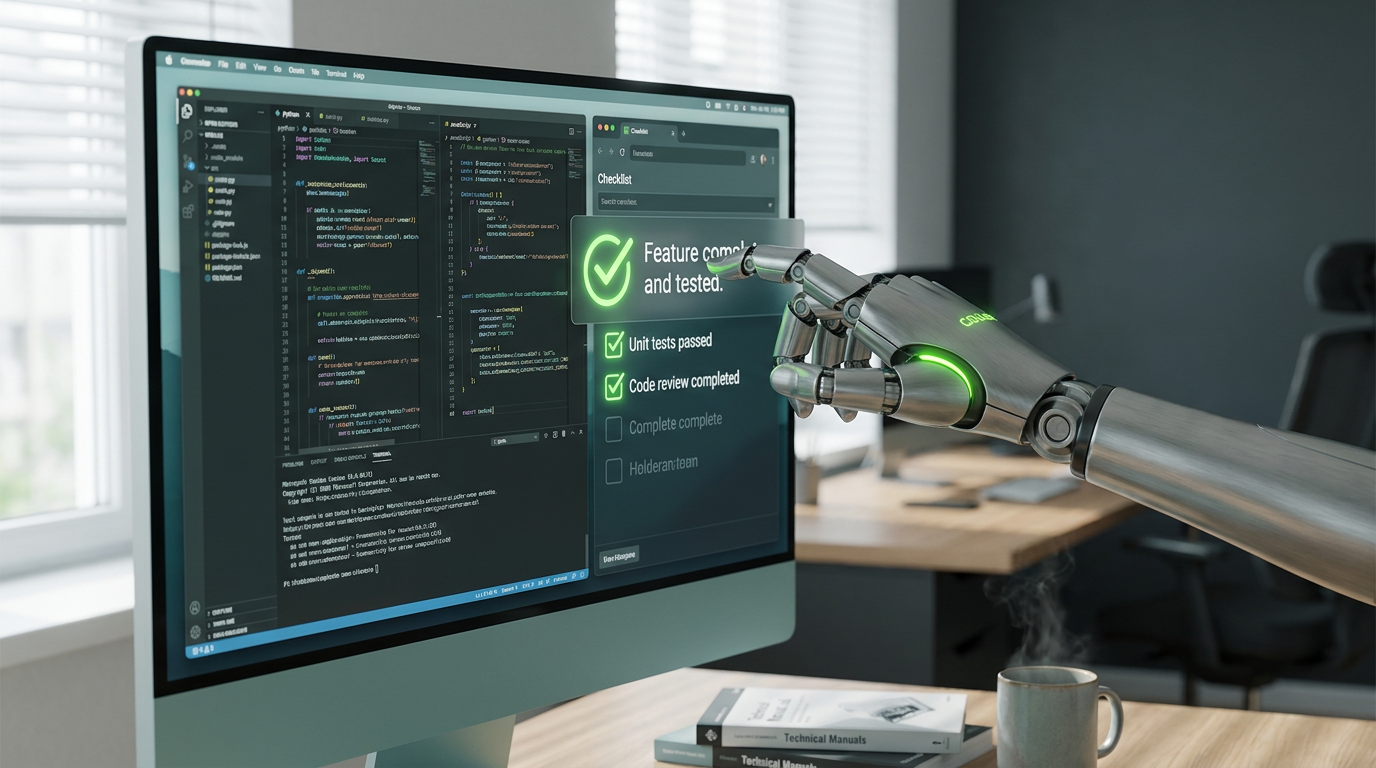
Claude Code for Business Leaders: What It Is and Why It Matters
Anthropic's Claude Code doesn't just suggest code — it plans, writes, tests, and fixes it. Here's what that means for your business.
If you've heard your developers mention "Claude Code" and pictured a fancier autocomplete, it's worth a second look. This isn't a tool that finishes your sentence — it's a tool that can be handed a task and come back with it done, tested, and verified.
For a business owner or operations leader, the distinction matters less as a technical detail and more as a question of what your team can now get done in a day.
Chatbot, autocomplete, or something else
Most people's mental model of AI coding help falls into one of two buckets. There's the chatbot: you ask a question, it gives you an answer, and a human decides what to do with it. And there's autocomplete: it predicts the next few lines of code as a developer types, saving keystrokes.
Claude Code is a different category, usually called "agentic." Instead of answering a question, it's given a goal — "fix this bug," "add this feature," "update our dependencies" — and it works the goal itself. That means it can:
- Read through an entire codebase to understand how the pieces fit together, not just the file in front of it
- Break a task into steps and work through them in order
- Actually run the code and the test suite to see if its changes worked
- Notice when something failed and fix its own mistake, then re-test
That loop — try something, check the result, correct course — is the real shift. A chatbot tells your developer what it thinks might work. An agentic tool does the work and shows you the test results.
What this looks like day to day
The practical impact shows up in three places we hear about most from technical teams.
Internal tools get built faster. Every business has a wish list of small internal tools nobody had time to build — a script that reconciles two systems, a dashboard that pulls scattered reports into one place, a form that replaces an email chain. These projects are useful but rarely urgent enough to justify a developer's full week. Agentic tools shrink that week to a day or two, which means more of that wish list actually gets built.
Technical debt gets cleaned up instead of ignored. "Technical debt" is the accumulated shortcuts and outdated code every growing system picks up over time. It's rarely anyone's top priority because it doesn't produce a visible result — until it causes an outage or slows down a new feature. Because Claude Code can read a large, messy codebase and make consistent changes across many files at once, this kind of maintenance work that used to sit at the bottom of the backlog for months is now something a developer can assign and review in an afternoon.
Repetitive engineering work gets automated. Updating a library across dozens of files, migrating a data format, writing routine tests for existing code — this is necessary work that consumes senior developer time without using much of their judgment. Handing it to an agentic tool frees your best technical people for the decisions that actually need a human.
Put together, this is the kind of shift that can turn a multi-day maintenance project into an afternoon of review. That's not a marketing claim — it's the direct result of a tool that can read, write, run, and verify code in the same loop a human developer would, just faster.
This is part of a broader shift in how AI tools are showing up in day-to-day operations, not just software development — you can see more of what we mean on our AI services page.
What it doesn't replace
Here's the part that matters most, and where hype tends to get it wrong: Claude Code still needs a developer or technical lead in the loop.
It writes and tests code well, but it doesn't understand your business the way your team does — which shortcuts are acceptable, which systems are too fragile to touch casually, which "small" change might have downstream consequences it can't see. It can verify that its code runs and passes tests; it can't verify that it built the right thing for your business.
Think of it as a highly capable junior engineer who never gets tired and works fast, not a replacement for having engineering judgment on staff. If your business doesn't have any technical oversight today, this tool doesn't change that — you still need someone who can review what it produces, ask whether it's the right approach, and catch the mistakes that pass every automated test but are still wrong for your situation.
Where it genuinely shines is as a force multiplier for the technical people you already have or are considering hiring. A single developer with agentic tools can reasonably take on more than they could before. That's a real productivity gain — it's just not the same thing as needing zero technical staff.
Where this fits in your AI maturity
Adopting a tool like Claude Code isn't just a productivity tweak — it's a signal about where your organization sits on two of the six dimensions in our AI Business Maturity Model (AIBMM): Technology (are you adopting AI tools deliberately, with the right guardrails) and Talent (does your team have the skills and oversight to use them well).
An organization that hands agentic tools to developers without any review process is taking on risk. An organization that never explores these tools at all is leaving real productivity on the table. The maturity question isn't "should we use AI coding tools" — it's "do we have the right process, skills, and oversight around them."
If you're not sure where your organization stands on that spectrum, our AI Business Maturity Assessment walks through all six dimensions and gives you a clear read on where to focus next. And if you'd rather just talk it through, contact us — we're happy to help you think it through.