Construction IT: Why the Jobsite Is Your Weakest Network
The jobsite trailer is the weakest network you own, and it holds the plans, the change orders and the photos. What to do about it without buying enterprise gear for a site that moves.
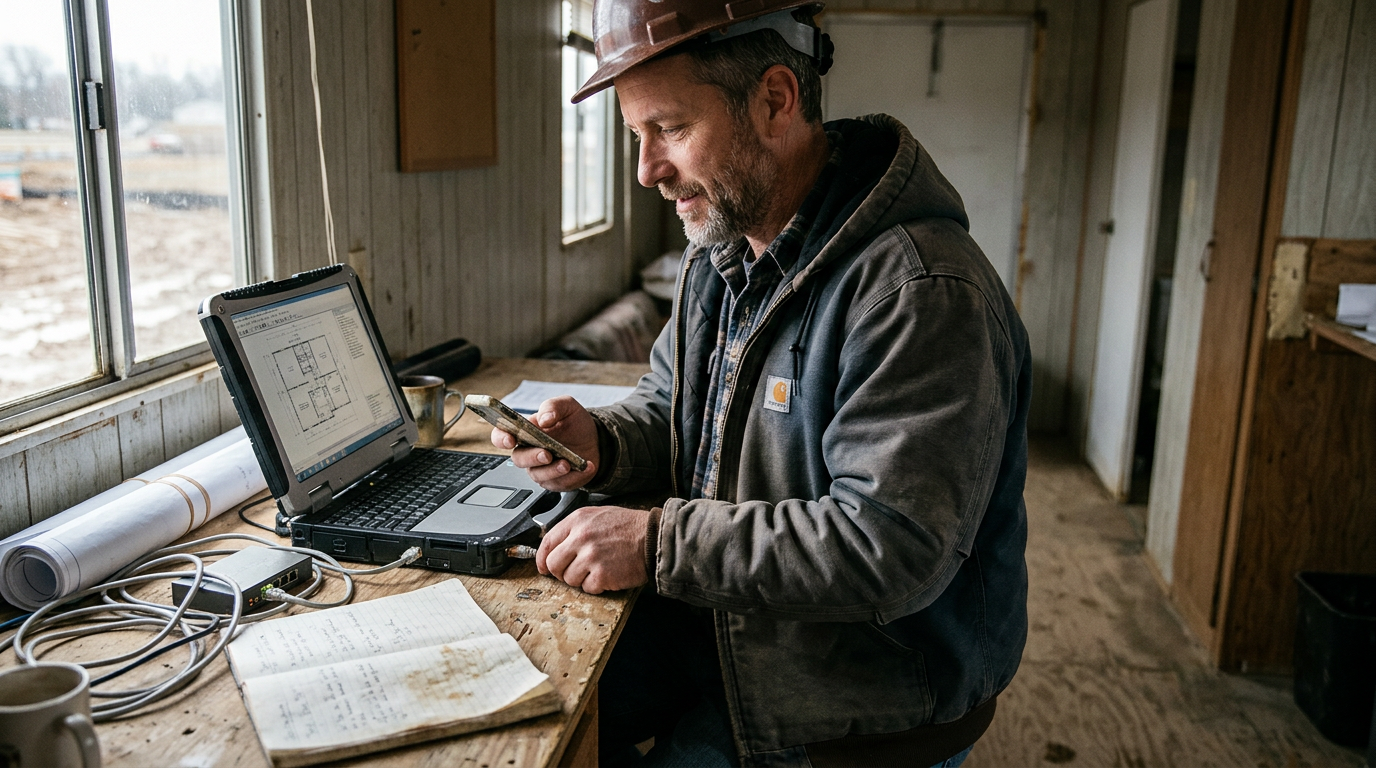
Your project trailer holds every document that proves what work was done, when it was done, and what it cost. Contract drawings and as-builts. Submittals and RFI responses. Daily reports and safety documentation. Change orders and pay applications. If that trailer's network goes down or gets breached, your entire job record disappears or lands in the wrong hands.
Most construction firms don't treat the trailer like the critical asset it is. The Wi-Fi is consumer-grade. The password is shared across the whole crew and every subcontractor who walks in. Devices sit on a flat network with no separation between a superintendent's laptop, a camera feed, and a visitor's phone. When something fails, and it will, the whole site feels it.
Why the Trailer Is Your Weakest Link
Jobsite networks are inherently more fragile than office networks. Without proactive planning and monitoring, outages are a matter of when, not if.
The environment itself is hostile to equipment. Routers and switches in trailers operate in dust, heat, and vibration that office gear never sees. Hardware fails faster. Connectivity is often cellular in early project phases, and while 5G has improved coverage, integrating it across multiple sites still presents real challenges. Even when you have a solid internet connection, a single consumer-grade router is a single point of failure for the entire operation.
The security exposure is worse. Many jobsites rely on consumer-grade Wi-Fi, shared passwords, and flat networks with no separation between devices. That creates broad exposure across every crew member and subcontractor connected to it. Your bid documents, client financial information, employee records, and subcontractor agreements all sit on the same unprotected network. Construction companies handle exactly the kind of sensitive data that makes them attractive ransomware targets, and because IT isn't the core business, cybersecurity often falls to the bottom of the priority list.
If you operate across multiple states, regulatory pressure is mounting. State-level data privacy laws increase the compliance burden, especially for multi-state contractors. Noncompliance can result in fines, breach notifications, and contract disputes.
What Actually Lives in the Trailer
The project file server in the trailer is the single point of failure for the entire job. Every document that proves scope, cost, and timeline lives there. Lose access to it for a day, and your crew loses 1–3 hours dealing with slow connections, missing files, or unresolved issues. Lose it permanently, and you've lost proof of what was built.
Construction sites often have large physical footprints and utilize a wide range of mobile devices, making perimeter security difficult. A subcontractor's phone, a superintendent's tablet, a camera system, a time clock, they're all on the same network, and they're all potential entry points.
What "Good Enough" Looks Like
You don't need enterprise gear to harden a jobsite network. You need a plan and the right baseline.
Start with a business-grade firewall. Replace the consumer router with a managed firewall that can handle multiple sites, enforce policies, and give you visibility into what's happening on the network. This is the single biggest move.
Segment your Wi-Fi. Run at least three separate networks: one for corporate devices and project files, one for IoT and cameras, and one for guests and subcontractors. A crew member or sub on the guest network can't see the project server. Simple, and it cuts your exposure dramatically.
Use cellular as your primary connection. Pair it with a secondary wired link if the job demands it, inspections, submittals, time-sensitive uploads. Cellular is more resilient than a single fiber or cable connection, and it keeps you online if the trailer's main line goes down.
Require MFA on every account. Multi-factor authentication on email, file access, and project management tools. It's not perfect, but it stops the majority of break-ins cold.
Enforce mobile device management. If a phone or tablet accesses project files, it needs to be enrolled in MDM. You can wipe it remotely if it's lost or stolen, and you can enforce a password policy across the whole fleet.
Add basic monitoring. You don't need a security operations center. You need alerts when a router restarts, when bandwidth spikes, or when someone tries to access the file server from an unusual location. Most managed IT providers include this as standard.
The Cost of Doing Nothing
Field teams lose time to slow connections and missing files. That's a direct hit to productivity and schedule.
Ransomware is a real threat. Construction firms are targeted because they hold valuable data and often lack the defenses to stop it. A breach can shut down a job, expose client information, and trigger regulatory fines.
Operational technology devices, cameras, time clocks, equipment trackers, are easy targets when connected to the public internet. According to CISA guidance, OT devices lack authentication resistant to modern threats and are quickly found by searching for open ports on public IP ranges. Removing them from direct internet exposure is a foundational defensive move.
What to Budget
IT spend in construction typically runs between 1.4% of revenue and 1.7% of operating expense, or roughly $6,700 per employee. That's a baseline for the whole operation, office, field, everything.
For jobsite-specific support, managed IT services for construction companies with 25–75 employees typically cost between $150 and $225 per user per month, depending on security requirements, backup needs, jobsite support, and remote needs. That covers the firewall, segmented Wi-Fi, mobile device management, monitoring, and someone to answer the phone when something breaks.
Where to Start
If your trailer network is still running on a consumer router and shared passwords, fix these three things first:
-
Replace the router with a business-grade firewall. This is non-negotiable. It's the foundation of everything else.
-
Set up segmented Wi-Fi. Corporate, IoT, guest. Three networks. Takes a day to configure and changes your security posture immediately.
-
Enforce MFA and basic MDM. Start with email and project management tools. Expand from there.
The fix is rarely a software setting. Someone has to walk the trailer, swap the equipment, and stand up the segmentation. If you run multiple active sites, a flat-rate managed model means you get a predictable monthly cost instead of surprise bills every time a router fails.
Book a jobsite network review, we'll walk the trailer, map what lives on it, and put together a flat-rate managed plan that covers every active site.