
AI Adoption Consulting
Independent advice on where AI actually pays off in your business, what to do first, and what to leave alone — from the people who wrote the maturity framework other consultants are certified in.
Coulee Tech provides AI adoption consulting to small and mid-sized businesses across Wisconsin, Minnesota, Iowa and Florida, from offices in La Crosse, Eau Claire and Fort Myers. The engagement is led by Rod Holum — the creator of the AI Business Maturity Model, the five-level framework that AIBMM-certified coaches nationwide are trained in, and a Certified AIBMM Master Coach.
In practice that means an independent assessment of where AI would genuinely remove hours from your operation, a shortlist of use cases ranked by effort against benefit, a sequenced roadmap you can actually fund, a written acceptable-use policy, and help running the first pilot. Typical clients run between 15 and 250 people: manufacturers, clinics, law and accounting firms, dealerships, and professional-services businesses.
Most AI projects fail for reasons that have nothing to do with AI
The technology is rarely the constraint any more. The tools are capable, cheap relative to a salary, and improving faster than any adoption plan can keep up with. What goes wrong is almost always organisational: nobody identified which specific task was being replaced, nobody owned the rollout, and nobody measured whether the hours actually came back.
That is what this engagement is for. It is a business analysis exercise that happens to be about AI — the same discipline you would apply to any operational change, brought by people who have watched enough of these succeed and fail to know which signals matter.
We are also willing to tell you that a use case is not ready, that a competitor's impressive-sounding deployment is mostly theatre, or that the honest first step is fixing a process before automating it. Advice you cannot get a "no" from is not advice.
We are not certified in someone else's framework. We wrote the one they are certified in.
Most AI consultancies assess your business against a model they licensed, adopted, or assembled from a conference talk. The AI Business Maturity Model — the five-level framework running from AI Drifter through Prompted Operator, Agent Builder and Agent Manager to Physical Integrator — was created by Rod Holum, our CEO.
You do not have to take that on faith. Rod's certification and the coaches trained in the model are listed in the public AIBMM speaker directory, where firms across the country appear alongside us. The difference is not the badge — it is that the framework was written here.
For an engagement, this changes something concrete. When your situation does not fit the model cleanly — and interesting businesses rarely do — a certified consultant has to apply the framework as written. We can tell you which part of it your case is actually testing, and why. The judgment behind the assessment and the assessment itself come from the same place.
The three ways it usually goes wrong
We have seen each of these enough times to design the engagement around avoiding them.
Buying tools before finding the problem
Licences get purchased organisation-wide, used enthusiastically for three weeks, and quietly abandoned. Nothing was wrong with the tool — nobody had identified which specific task it was supposed to replace.
Piloting something that cannot scale
A promising experiment runs on one person's personal account with data nobody has cleared for external processing. It works, everyone is pleased, and it can never be rolled out.
No policy until an incident
Staff are already using AI at work whether it has been sanctioned or not. The question is only whether there are rules about what they may paste into it.
What an engagement produces
Scoped to what you need — some clients want the full sequence, others want one question answered well.
AI opportunity assessment
We inventory how work actually gets done in your business, then identify where AI would remove real hours — and, just as importantly, where it would not.
Prioritised use-case shortlist
Candidate uses ranked by effort against benefit, so the first project is one that can succeed rather than the one that sounded most impressive in a meeting.
A sequenced roadmap
What to do this quarter, this year, and not yet — sequenced against your budget and your team's capacity to absorb change.
Tooling recommendations
Which assistant, which licences, and which integrations, chosen for your workflow rather than whichever vendor is loudest this quarter.
Governance & acceptable use
A written policy covering what staff may put into which tools, who reviews AI output before it reaches a client, and how that gets enforced.
Rollout & enablement
Adoption fails on habit, not technology. We help you run the pilot, train the people who will use it daily, and measure whether it stuck.
Should you hire us, or someone else?
There are four real options for AI adoption help, and for two of them the honest answer is often not us. Here is how we would describe them if you asked over coffee.
A national consultancy
Slalom, West Monroe, the Big Four
Best when
Enterprise-scale transformation with a change-management team, a multi-year budget, and internal staff to receive the work.
The catch
The engagement model assumes a client with a programme office. Below a few hundred employees the fee and the overhead both stop making sense, and the partner who sold it is rarely the person who shows up.
Your state's MEP centre
NIST MEP, WCMP in Wisconsin, IMEC in Illinois
Best when
Manufacturers who want subsidised, credible, vendor-neutral help. These are genuinely good programmes and often the cheapest serious option available.
The catch
Grant-funded scope and timelines, manufacturing-shaped by design, and no ongoing relationship with whoever runs your systems afterwards. If you are a law firm, a clinic, or a dealership, you are outside their remit.
Your existing IT provider
the MSP you already pay monthly
Best when
Anything that is really an infrastructure question — licences, identity, data access, security posture.
The catch
Most MSPs are reselling an AI product line, not advising on adoption. Ask who at the firm has assessed AI maturity outside of a vendor's sales deck, and how many times.
Coulee Tech
That's usWisconsin, Minnesota, Iowa & Florida
Best when
Owner-led businesses of roughly 15–250 people who want the assessment done properly by the people who wrote the assessment, and who would rather one firm handle both the advice and the systems underneath it.
Where we are the wrong call
We are a regional firm. If you need a hundred consultants in eleven cities next quarter, we are the wrong call and will say so on the first conversation.
Who you would actually be working with
AI consultant is a title anyone can print on a card. These are the credentials behind ours — each one checkable without taking our word for it.
We did not adopt the framework — we wrote it
The AI Business Maturity Model was created by our CEO, Rod Holum, a Certified AIBMM Master Coach. Coaches at firms around the country are certified in it, and the roster and tiers are public at aibmm.ai/speakers.
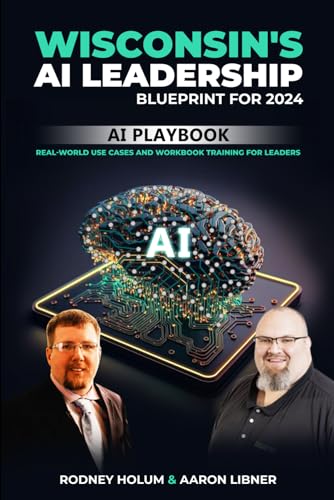
Seven published books
Four on AI adoption for business leaders, three on cybersecurity — written by our CEO and our Eau Claire market president.
Requested to teach it, not just sell it
Our CEO is asked to speak around the country: AI for military leadership including generals, AI for HR at the Chippewa Valley SHRM chapter, plus CEO, nonprofit, and business audiences, and a free AIBMM webinar the first Friday of every month.
You can watch us work first
A full-day, hands-on AI Business Retreat with coaches flying in from around the country — attend before you ever sign an engagement.
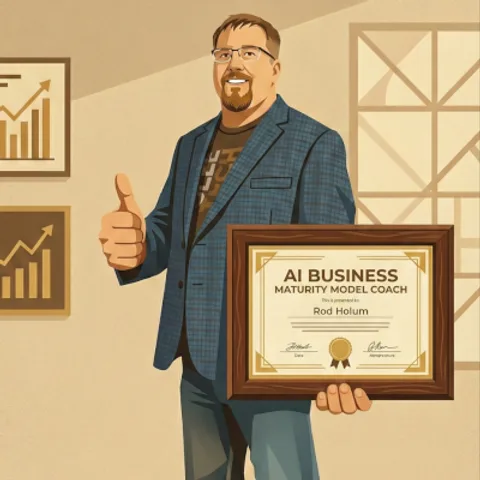
Rod Holum
Certified AIBMM Master Coach
CEO & Founder, Coulee Tech · La Crosse, WI
Created the AI Business Maturity Model and holds the Master Coach certification in it. He runs the assessments and the executive roadmap work himself, and is a requested speaker around the country, teaching the model to CEOs, military leadership, nonprofits, and business groups.
Verify the certification →
Aaron Libner
Certified AIBMM Executive Coach
President, Eau Claire Market · Eau Claire, WI
Leads adoption work with owners, sales teams and non-profit boards across the Chippewa Valley, in deliberately non-technical language.
Verify the certification →Both profiles are listed publicly in the AIBMM coach directory.
We have had to write this down
Four books on AI adoption for business leaders, built largely on what actually happened at real companies in our markets rather than on vendor case studies. Three more on cybersecurity, which is the constraint that decides what AI you can safely put your data into.
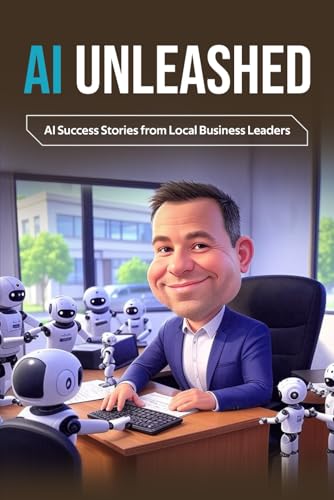
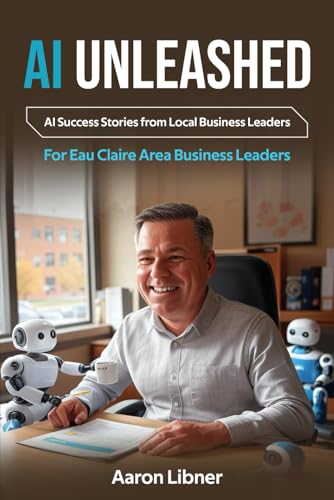
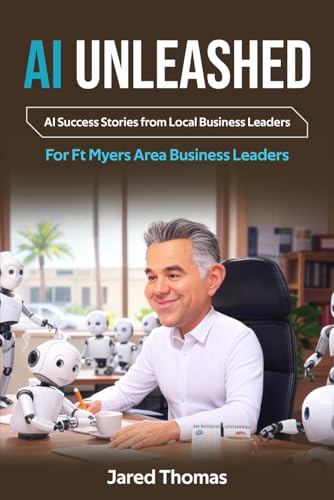
Go Hands-On: The AI Business Retreat
Join our one-day AI Business Retreat in Spooner, WI. Learn the AI Business Maturity Model, build a working AI agent, and leave with a written 90-day roadmap — in person or live remote.
Explore the AI Business Retreat →AI adoption consulting: common questions
Not sure where AI fits in your business?
That is the question the first conversation answers. Bring your operation, not a shortlist of tools.