Direct Mail That Reads Minds: AI-Personalized Postcards, Explained
AI personalized direct mail, explained: how AI writes each postcard, what data stays off the card, and how a small business can test one campaign.

In this article
AI personalized direct mail is a postcard campaign where an AI model drafts a different message for each person on your list. It works from a few facts you already have, such as their industry, their town and a problem common to businesses like theirs. A printer then merges those messages onto the cards and mails them. It does not read minds. It reads your list. The card is only as good as that list, the rules you give the AI, and the person who checks every message before it prints.
That was the subject of a session at the AI Business Retreat in Spooner, Wisconsin, on September 15, 2026. Below is what the session covered, how the process works, what data belongs on a card, and how to run one small test before you mail your whole list.
What the Spooner session covered#
Direct Mail That Reads Minds: AI-Personalized Postcards was a 30-minute session in the retreat's Sales and Marketing Track, scheduled for 3:00 to 3:30 PM and taught by Aaron Libner, a Certified AIBMM Executive Coach and President of Coulee Tech's Eau Claire market. The session page describes its audience as growth-minded owners and marketing leaders looking for a channel competitors have abandoned.
The session page lists three parts:
- Why the empty mailbox is your opportunity.
- A segmented, personalized card set drafted in-session.
- From list to letterbox: how the printing and mailing actually runs.
The stated takeaway was "a personalized mail campaign, drafted." That is the right frame for anyone trying this. The AI produces a draft that a person reviews. It is not a machine that mails on its own.
On the first point, the mailbox is not literally empty, but it is getting quieter. The Postal Service reported (opens in a new tab) that in fiscal 2025, Marketing Mail volume fell 1.3 percent and First-Class Mail volume fell 5.0 percent compared with the prior year. A card that plainly speaks to the reader's trade and town gives them a reason to read it before it goes in the recycling.
How AI personalized direct mail works#
Three different approaches get called "personalized postcards." They are not the same thing.
| Approach | What changes on each card | Who writes the words | Main weakness |
|---|---|---|---|
| Mail merge | Name, address, maybe the company name | You, once | Every card says the same thing |
| Variable data printing | Blocks of text, images or offers, picked by rules you set | You, one version per rule | Someone has to write every version |
| AI-personalized mail | A short message drafted for each segment or each row | AI drafts, a person approves | It can invent details if you let it |
Variable data printing is the printing side. The printer's software takes one design and one spreadsheet and fills different text or images into each card as it prints. AI changes the writing side. Instead of you writing six versions by hand, the AI drafts one per segment or per row, and the printer gets the same kind of spreadsheet it already uses.
From list to letterbox in five steps#
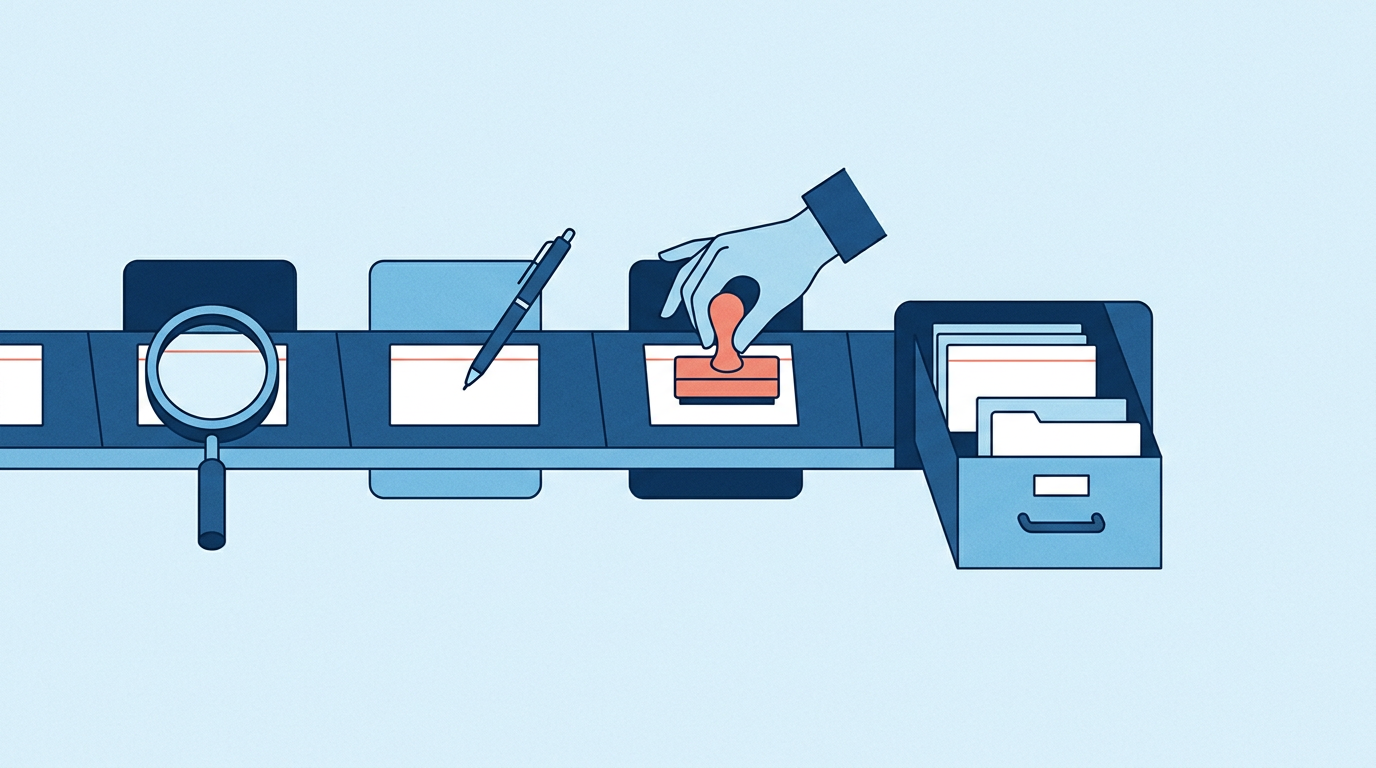
- Build the list. One row per prospect: business name, contact name and role, mailing address, industry, town and a short response code for tracking. Add one column for anything you know and have verified, such as "customer since 2022" or "asked for a quote in March."
- Segment it. Group rows by industry and area. You can move to one card per row once the segment version works.
- Prompt with rules. Give the AI one segment, your offer and strict rules (a sample prompt follows). Ask for the output as columns you can paste back into the spreadsheet.
- Review every card. A person reads each message against its row. Anything the AI added that is not in the row gets cut.
- Hand off to the printer or mail house. They merge the spreadsheet into the design, clean the addresses, sort the mail and send it.
A prompt you can adapt#
Picture a hypothetical 15-person commercial cleaning company in La Crosse mailing dental offices, auto dealers and small manufacturers around the Coulee Region. A prompt along these lines keeps the AI inside the lines:
You are writing postcard messages for a commercial cleaning company in La Crosse, WI.
For each row in the attached list, write a headline (8 words max) and a body (35 words max).
Rules:
1. Use only facts that appear in the row. Do not invent events, numbers, awards, people or details about the business.
2. Mention the town and the type of business once each, naturally.
3. Raise one problem common to that industry as a question, never as a statement about them.
4. One offer only: a free after-hours walkthrough. One call to action: call 608-555-0100 and mention the code in the row.
5. Plain, friendly voice. No exclamation marks. No dashes used as punctuation.
Return a table with the columns row_id, headline, body.
Rule 1 does most of the work. Without it, a model can congratulate a business on an anniversary or an expansion that exists nowhere in your data, and the recipient will know it is wrong.
What data belongs on a card, and what stays off#
The session page sums up the inputs as each prospect's industry, neighborhood and likely pain. That is a sensible boundary. Here is how to hold it.
Fair to use
- Business name, contact name and role, and mailing address.
- Industry, town or neighborhood.
- Your own history with them: a past quote, a past purchase, an event they attended with you.
- Public facts you have checked yourself, such as a second location that opened this year.
- Problems common to their industry, asked as a question.
Off limits
- Anything personal or sensitive: health, finances, family, age, religion, politics, or anything from someone's personal social media.
- Anything that shows you were watching, such as "we saw you on our pricing page" or "we noticed your truck at the job site."
- Details the AI guessed or pulled from the web that nobody verified.
- Claims you cannot prove. The FTC's advertising guide for small businesses (opens in a new tab) says it plainly: "The law requires that advertisers have proof before the ad runs." That applies to a sentence an AI wrote exactly as it applies to one you wrote.
A simple test: if the recipient would be uneasy to learn you knew it, it does not go on the card.
How to test one AI direct mail campaign#
Do not start with your whole list. Run one test that answers one question: does the AI-personalized card get more responses than the card you would have sent anyway?
- Pick one offer and one audience. One service, one call to action, two or three industries in the area you actually serve.
- Split the list at random. Send half the AI-personalized card and the other half one generic card with the same offer, the same design and the same mail date. Split by coin flip, not by industry or town, or you will be comparing audiences instead of cards. The generic half is your control. Without it, you cannot tell whether personalization did anything.
- Size it to the postage. USPS Marketing Mail is bulk only: each mailing must be at least 200 pieces or 50 pounds (opens in a new tab). A smaller test mails First-Class. USPS has no lower postcard price in Marketing Mail, and in First-Class a card larger than the USPS postcard size limits (opens in a new tab) (4-1/4 by 6 inches at most) is charged as a letter. Settle the size with your printer before anyone designs.
- Clean the addresses. To claim Marketing Mail or presorted First-Class prices, USPS requires that mailers show they updated their list for moves within 95 days before the mailing date (opens in a new tab), using an approved method such as NCOALink. A mail house can usually run this for you. Ask yours.
- Make responses countable. Give each half its own code, phone number or short web address. Count calls, booked meetings and quotes. Track scans too, but a scan is not a response.
- Plan the follow-up before you mail. A postcard opens a conversation, and a call a few days after it lands continues it. Our write-up of Jer Holum's session on AI lead follow-up covers how to make sure that next touch happens every time.
- Pick the decision date in advance. Set a response window before you mail, then compare the two halves. If each half brings in only a handful of responses, treat the gap as a hint, not proof, and run it again before you change your whole program. Personalization costs review time. The test tells you whether it earned it.
A privacy note before you upload the list#
Your prospect list is information about real people. Treat the AI step like any other vendor that touches it.
- Send only the columns the card needs. The FTC's guide to protecting personal information (opens in a new tab) starts with "take stock" and "scale down": know what you have, and keep only what you need. The AI does not need phone numbers, private notes or anything on the off-limits list to write a postcard.
- Use an approved business AI account, not a personal free one. If staff are already pasting company data into chat tools, start with our post on shadow AI and what to do about it.
- Honor removal requests. Keep a do-not-mail list and check every new list against it. Consumers can also cut promotional mail through DMAchoice, which the FTC's guide to stopping junk mail (opens in a new tab) describes as a service of the Association of National Advertisers.
This is general information, not legal advice. If your offer touches credit, insurance, health care or another regulated area, or you buy lists from a broker, check with your attorney before you mail.
Frequently asked questions#
What is AI personalized direct mail?#
It is printed mail, usually postcards, where an AI model drafts a different message for each recipient or segment from the data in your list. A printer then uses variable data printing to put each message on its own card. A person should review every message before anything prints.
Is AI direct mail the same as variable data printing?#
No. Variable data printing is the printing technology that lets each card carry different text or images. AI is a way to write those variations. You can use variable data printing without AI, and an AI-personalized campaign still relies on it at the printer.
How many postcards do I need for a test?#
USPS Marketing Mail requires at least 200 pieces or 50 pounds per mailing, so a smaller test mails at First-Class prices. Whatever size you choose, split it at random between a personalized version and a generic control so the comparison means something. Settle the card size with your printer first, because size changes the postage.
Which AI tool do I need to write personalized postcards?#
A capable general-purpose AI assistant can draft the messages if you give it clear rules and a clean spreadsheet. Use a business account with data controls, and keep a person in the review step. Our buyer's guide to ChatGPT, Claude and Grok compares the main options for a small business.
Can personalized direct mail feel creepy?#
Yes, when the card shows you know something the recipient did not expect you to know. Stick to their business, their town, their industry and your own history with them. Personalization should read as relevant, never as watchful.
Where to go next#
You do not need a retreat seat to get started with AI. Coulee Tech runs a free AIBMM webinar on the first Friday of every month at 8 a.m. Central. It is the easiest way to see how we teach before you spend anything. For hands-on sessions built around your own staff, see our AI training for business, or look at our AI coaching and adoption services if you want a coach alongside your first real AI project.